// previous briefing Bitcoin Analysis May 19, 2026: Sellers Press Control
Bitcoin Market Read for May 20, 2026
If you are long Bitcoin, one thing matters more than the latest rebound this morning. The lift into the last close repaired some intraday damage, but it did not change where supply has been active: BTC is still responding faster to selling pressure than to recovery attempts. That keeps the read protective rather than opportunistic, especially with the system flat and the current signal leaning towards reducing exposure rather than adding risk.
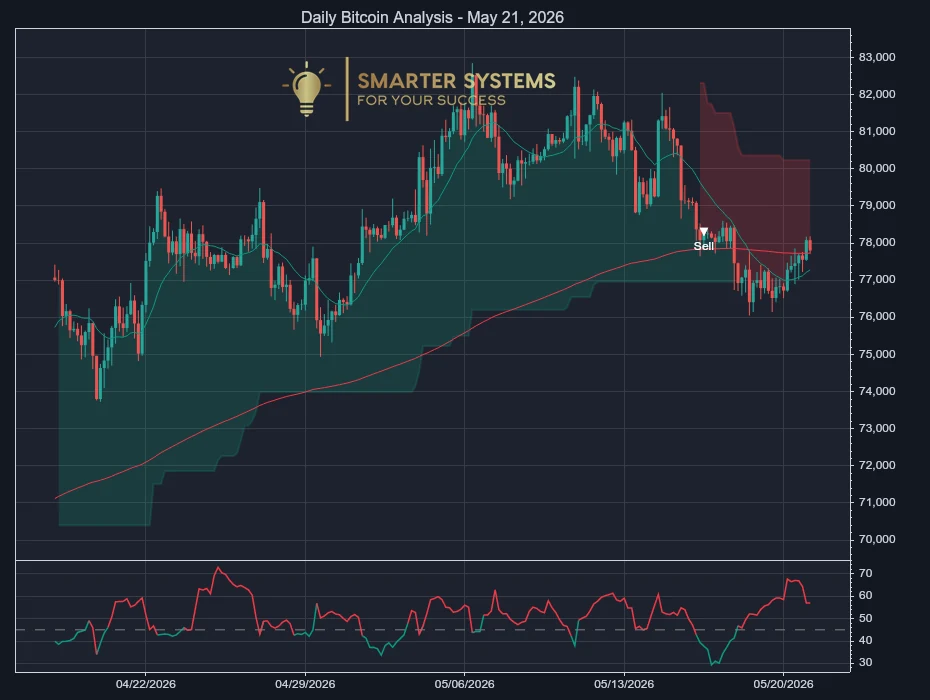
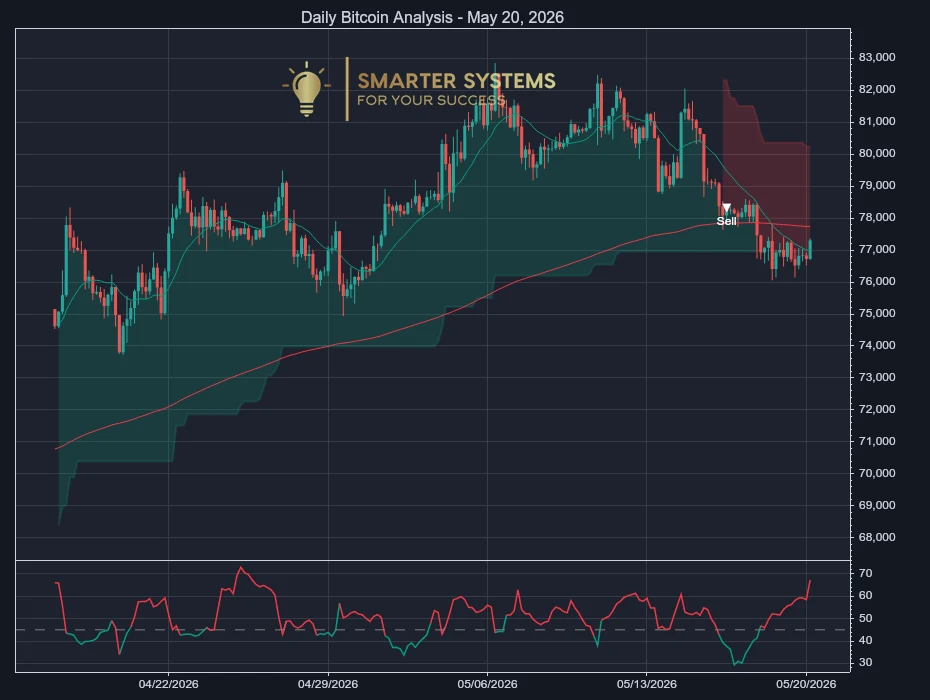
Bitcoin’s latest push has improved the immediate tone, but it has not yet repaired the larger sequence. The last close on BTCUSDT sits at 77304.4, following a recovery that reached back into the area where sellers previously slowed the market. That matters because the move arrived after a lower close earlier in the session, not after a clean base. Buyers did step in, and they did so with enough force to lift BTC away from the local lows, but the response is still best read as a test of resistance rather than evidence that control has changed. The cryptocurrency market often rewards patience at this point in a decline: the first sharp recovery can look persuasive because it relieves pressure, while the next pause reveals whether larger capital is prepared to absorb supply. That is a very different condition from a market where dips are absorbed quickly and sellers are forced to chase price higher. Here, recovery still has to prove it can survive contact with resting supply. For now, the directional bias remains defensive. Long exposure needs proof that buyers can hold higher ground without immediately giving back the advance.
Compared with the prior stretch, the most recent move carried a wider high-low range while trading volume only increased modestly. That combination is important. The increase in activity was present, but it was not broad enough to erase the earlier imbalance. Wider movement without a decisive expansion in participation can reflect urgent covering and tactical buying, not necessarily fresh investment demand. Earlier in the sequence, heavier participation appeared during the push lower, which gives the sell side more credibility than a quiet rebound would remove. The price action is also choppy rather than smooth. Bitcoin is not falling in a straight line, and that makes the market harder to read from the headline close alone. The rebounds are real, but they are arriving inside a structure where sellers have repeatedly appeared before buyers could build durable momentum. In practical terms, support has become something to observe rather than assume. If buyers are serious, they should defend pullbacks with less effort and less spread than the market needed to produce this rebound. Until that happens, the bounce remains part of a difficult market structure, not a clean shift in control.
The confirmed down-trend reading gives the Sell signal more weight than it would have in a directionless market. A Sell signal here does not have to mean immediate weakness; it means the burden of proof sits with buyers, and that risk management should come before optimism. For investors already carrying meaningful Bitcoin exposure, the setup argues for reviewing size, taking partial profits where appropriate, or delaying new allocation until the market shows that demand can persist after the initial lift. The system is flat and watching, which is a useful reflection of the tape rather than a lack of conviction. There is enough movement to punish late sellers, but not enough quality in the recovery to justify assuming the decline is finished. Choppiness adds to that caution because it can pull capital into poor entries on both sides. A stronger read would require Bitcoin to stop treating each approach toward resistance as a liquidity event for sellers. Until then, momentum remains suspect even after a constructive final bar. Portfolio decisions should therefore be paced around evidence of acceptance at higher prices, not the comfort that comes from a single strong rebound after pressure.
Current System Positioning
The system is Flat, status idle, and has been out of position for 23 bars. That stance fits a market where the Sell signal favours restraint, with no active Long or Short exposure.
What to Watch Next
Today’s most useful marker is the quality of BTC’s first pullback after the rebound. A constructive tape would show shorter declines, quieter trading volume, and support forming without buyers needing another forceful recovery. The current read starts to weaken if sellers drive price quickly back into the prior lows with broader participation, because that would show resistance remains the dominant feature.
Frequently Asked Questions
The Sell signal means the rebound should be treated with caution rather than assumed to be a durable turn. In a confirmed down-trend, it favours reducing exposure, taking profits where appropriate, or waiting for stronger evidence that buyers can absorb supply.
The recovery improved the immediate tone, but it followed earlier selling pressure and came with only a modest increase in participation. That creates uneven price action: buyers can lift the market, yet sellers still appear before momentum becomes convincing.
Investors should reassess when the next pullback shows whether buyers can defend higher ground with less effort. Quieter selling near support and a cleaner push back towards resistance would improve the read more than a single rebound alone.
The system is Flat because the recovery has not yet outweighed the broader down-trend and Sell signal. Being idle here reflects restraint: there is movement, but not enough evidence that demand has taken control from sellers.
// disclaimer This briefing is educational market commentary from a rule-based system. It is not financial advice and not a personal recommendation. Cryptocurrency is highly volatile, and past signals do not guarantee future results. Only invest money you can afford to lose. Read the full disclaimer.