// previous briefing Bitcoin Analysis June 1, 2026: Sellers Test Support
Bitcoin Market Read for June 2, 2026
If you are long Bitcoin, one thing matters more than price this morning. The issue is not disorderly selling; it is that each attempted lift is arriving with less ability to reclaim ground while sellers press in a relatively smooth sequence. That makes the current setup more about protection than prediction. A Sell signal in a confirmed down-trend does not say collapse is inevitable; it says capital has fewer reasons to add risk until buyers prove they can defend more than a brief pause.
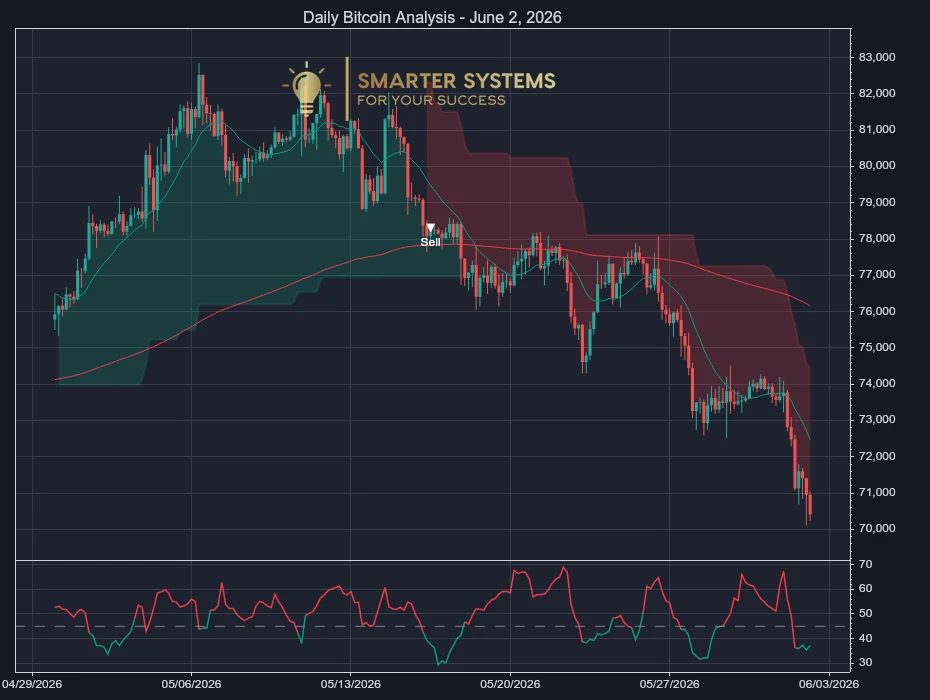
Bitcoin’s latest close at $70,414.29 leaves BTC pressing the lower side of the recent sequence rather than rebuilding from it. The recovery attempts that followed the sharp sell-off have not carried far enough to change the character of the tape. Sellers are not chasing every lower print, but they are meeting each bounce early, which keeps pressure close to support instead of allowing price to travel back toward resistance. That distinction matters for investors because weak rebounds often reveal more than fresh lows. On BTCUSDT, the market is showing hesitation from buyers at moments when a stronger response would normally appear. The system is flat and watching, which is consistent with that message: there is no need to force exposure while price action keeps leaning lower. For portfolio builders, the practical read is defensive. This is not a clean capitulation that clears positioning quickly, nor is it a strong reversal attempt. It is a market where downside control remains with sellers until buyers can absorb supply without immediately giving back the progress. The absence of panic should not be mistaken for strength; it simply means sellers are controlling pace without needing a surge in urgency.
The latest interval narrowed compared with the prior stretch, and trading volume fell noticeably at the same time. That combination deserves a careful read. Lower volatility after a push down can be constructive if buyers step in and hold the line with confidence, but that is not what stands out here. The quieter tape developed while price stayed heavy, so the decline in participation looks more like reluctance than accumulation. In a healthier repair, reduced volume would normally coincide with price stabilising above a defended area and then beginning to press sellers back. Here, market structure is still angled down, and the smaller high-low spread shows consolidation near weakness rather than initiative from demand. Across the broader cryptocurrency market, investors should treat this as a test of patience rather than a trigger for activity. The important detail is that selling pressure has become less frantic but not less effective. When sellers can make progress without expanding effort, it often means buyers are waiting for clearer evidence before committing capital. That waiting behaviour can last longer than expected because no obvious disorder is forcing rapid repricing.
The confirmed down-trend is the central point of the analysis, not an ornamental label. It means the burden of proof sits with buyers, because recent movement continues to produce lower recovery points and weaker defence after each sell wave. The Not Choppy reading adds useful nuance. This is relatively smooth pressure, not a messy back-and-forth that repeatedly traps both sides. In practical terms, that makes the Sell signal harder to dismiss as noise. It favours taking profits, reducing exposure, or postponing new allocation until the market shows that demand is willing to pay higher rather than merely react lower. Momentum is not accelerating in a dramatic way, but it remains aligned against fresh risk. That matters because some investors are tempted to buy every quiet spell after a decline. A quiet spell inside orderly weakness is different from a base. It can allow late longs to unwind without a scramble, while stronger hands wait for better evidence. The cleaner the descent, the more disciplined investors need to be about not confusing calm conditions with opportunity. This is why the current read is less about forecasting a large breakdown and more about recognising that the path of least resistance has not shifted back to buyers.
Current System Positioning
The system is Flat, idle, and 101 bars into that stance. That fits the current read: it is observing a pressured market rather than carrying directional exposure while sellers retain control of the tape.
What to Watch Next
Watch the next rebound into the area where the last bounce failed. A constructive shift would show sellers backing off there, trading volume improving on the lift, and the following pullback staying shallow rather than returning immediately to the intraday lows. The cleaner warning sign is a slow drift that keeps accepting lower prices without a visible fight; that would confirm that support is being used for exits, not accumulation.
Frequently Asked Questions
The Sell signal argues for caution rather than an automatic short. With the system Flat and idle, it favours taking profits, reducing exposure, or waiting for a stronger buyer response before adding risk. The confirmed down-trend keeps the burden of proof on demand.
The Not Choppy reading means the decline is relatively smooth rather than erratic. Sellers are pressing consistently, while rebounds are failing early. That makes the weakness more meaningful because it is not being driven by messy back-and-forth noise.
Reassessment is justified when the next rebound reaches prior supply and sellers no longer meet it quickly. Improving participation on the lift, followed by a shallow pullback that holds above the latest intraday weakness, would show a change in behaviour from hesitation to demand.
Lower trading volume after a sell-off is not automatically bullish. In this case, price stayed heavy while participation faded, which suggests buyer reluctance rather than confident accumulation. Long-term investors can remain selective until demand appears at higher prices.
// disclaimer This briefing is educational market commentary from a rule-based system. It is not financial advice and not a personal recommendation. Cryptocurrency is highly volatile, and past signals do not guarantee future results. Only invest money you can afford to lose. Read the full disclaimer.