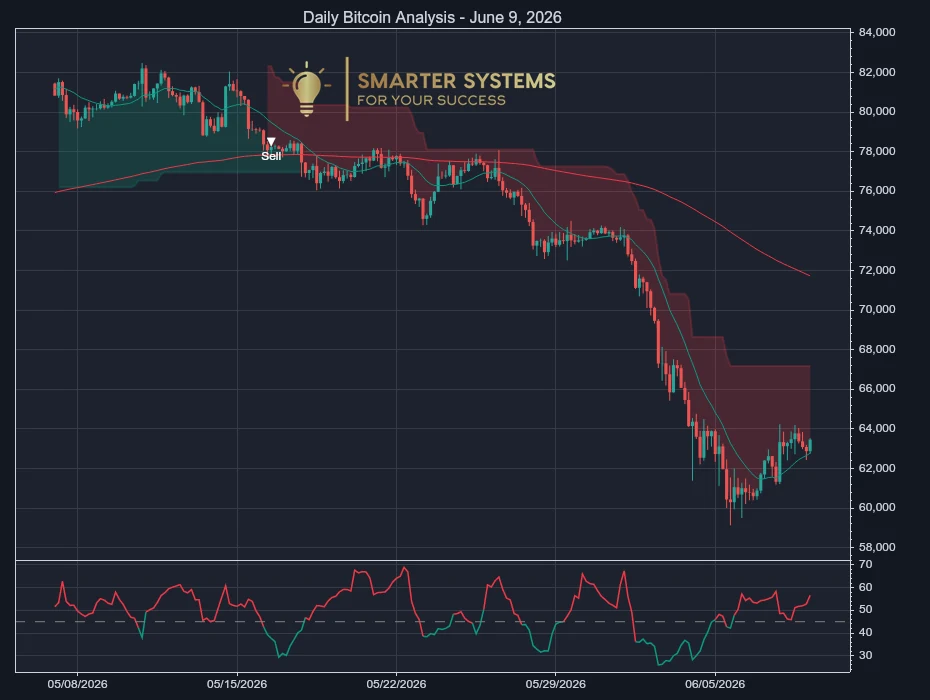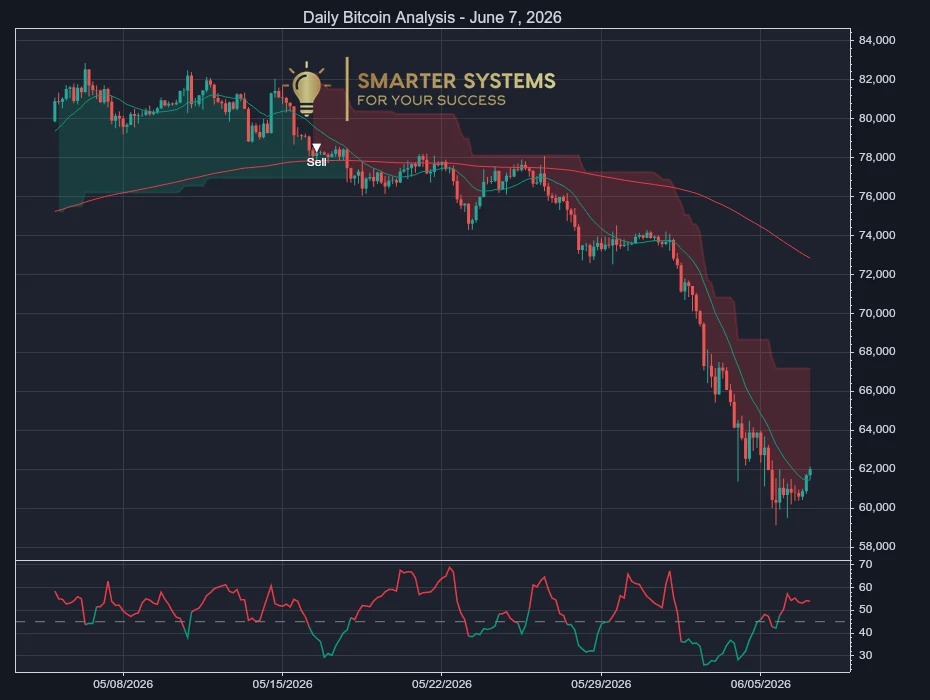
// previous briefing Bitcoin Analysis June 7, 2026: Sell Signal Meets Bounce
Bitcoin Market Read for June 8, 2026
If you are long Bitcoin, one thing matters more than price this morning. The recovery that briefly changed the tone has not drawn the kind of sustained participation that would force sellers to step back. Bitcoin is still being defended on setbacks, but the defence is slower and less convincing than the push that lifted BTC from its prior weakness. That combination matters because a Sell signal inside a confirmed down-trend is less about panic and more about respecting where pressure is returning.
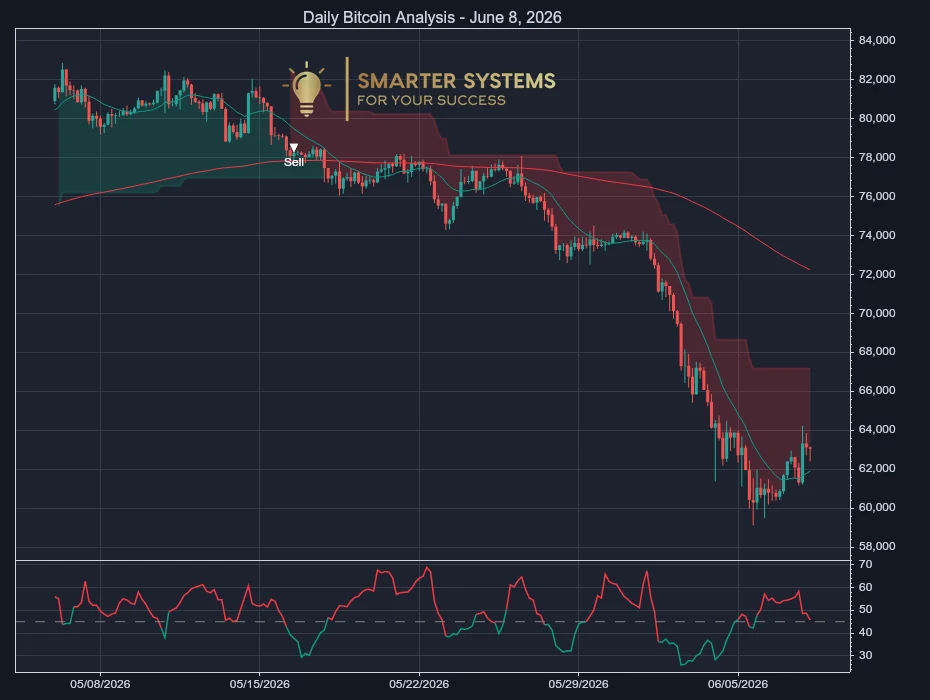
The current read is defensive, not disorderly. Bitcoin last closed at 63,062, and the immediate bias favours caution because the latest advance has started to lose pace near overhead supply. The prior rebound was sharp enough to unsettle late sellers, yet the next phase did not bring the same urgency from buyers. That is often where stronger hands become selective: they do not need to chase a move that has already absorbed easy demand. In BTCUSDT, the most useful detail is the quality of the pause. Price has not collapsed back through the whole recovery, but it has also not pressed higher with authority after the initial lift. For investors, that distinction matters more than a single intraday push, because defensive markets often offer convincing rallies before demand fully repairs. This leaves market structure tilted lower while participants decide whether the bounce was accumulation or simply a better place to reduce risk. The system is flat and watching, which fits the evidence. There is no need to force a long position when resistance is close enough to cap progress and support has not yet been tested with conviction.
Volatility has compressed since the previous interval, and that is the important behavioural change. The earlier upswing travelled through a much wider high-low span and attracted heavier trading volume, which showed urgency and a temporary scramble for exposure. The latest move has been narrower and quieter, so the market is no longer being carried by the same broad participation. That does not automatically make the bounce weak, but it does make it easier for sellers to lean against it. When a market advances on force and then pauses on thinner activity, investors should look at who is willing to defend the first meaningful setback. So far, the cryptocurrency market has not shown enough urgency around Bitcoin to suggest that capital is aggressively rebuilding risk. The price action is choppy because neither side is gaining clean control, but the chop is not random noise. Buyers are appearing after weakness, sellers are responding near the top of the rebound, and the spread between enthusiasm and restraint is narrowing. That is where short-term momentum can fade without a dramatic breakdown. It also explains why patience has value today.
The confirmed down-trend matters because it defines the burden of proof. In an improving market, a pause after a strong lift can be treated as constructive digestion. Here, it has to prove more, because sellers have already shown the ability to press Bitcoin lower and buyers have not yet turned that pressure into a durable sequence of higher closes. Choppiness adds another layer. It tells investors not to read every small push as decisive, especially when follow-through has been inconsistent across successive intervals. The Sell signal should therefore be read as a risk-management prompt rather than a prediction of immediate downside. For existing exposure, it favours taking profits, reducing leverage, or waiting before adding. For fresh capital, it argues for patience until buyers show they can absorb supply without needing a sudden burst of volume to do it. BTC can still stabilise from here, but stabilisation is not the same as control. The difference is participation: control would look like steady demand returning after a pullback, not just a fast recovery from a low-liquidity pocket. Until that appears, sellers retain the cleaner tactical argument.
Current System Positioning
The system is Flat, status idle, and 137 bars into that position state. This is observational: no active Long or Short exposure is being carried while the market remains choppy.
What to Watch Next
Today’s most useful marker is the next pullback into the area buyers defended after the recovery began. A shallow retreat with steadier participation would improve the read, because it would show demand returning without a forced chase. A heavier slide on expanding activity would keep the Sell signal in control and make the recent bounce look more like distribution into resistance. The quality of that test matters more than another brief push higher.
Frequently Asked Questions
The Sell signal is a risk-management cue, not a call for panic. With Bitcoin in a confirmed down-trend and the rebound losing pace, it favours taking profits, trimming leverage, or delaying new exposure until buyers show stronger participation after a pullback.
Bitcoin looks choppy because the forceful recovery was followed by a narrower, quieter phase. Buyers still appear on weakness, but sellers are responding near resistance. That mix creates hesitation rather than clean control, especially while participation is lighter than during the prior push.
The next pullback is the key test. A controlled retreat with steadier demand would improve the picture, while heavier activity on weakness would support the current cautious read. The quality of support matters more than a brief advance.
The system is Flat because the evidence does not justify forcing exposure. The down-trend remains confirmed, the action is choppy, and the Sell signal favours selectivity. An idle stance is consistent with waiting for cleaner buyer behaviour or a more attractive risk point.
// disclaimer This briefing is educational market commentary from a rule-based system. It is not financial advice and not a personal recommendation. Cryptocurrency is highly volatile, and past signals do not guarantee future results. Only invest money you can afford to lose. Read the full disclaimer.