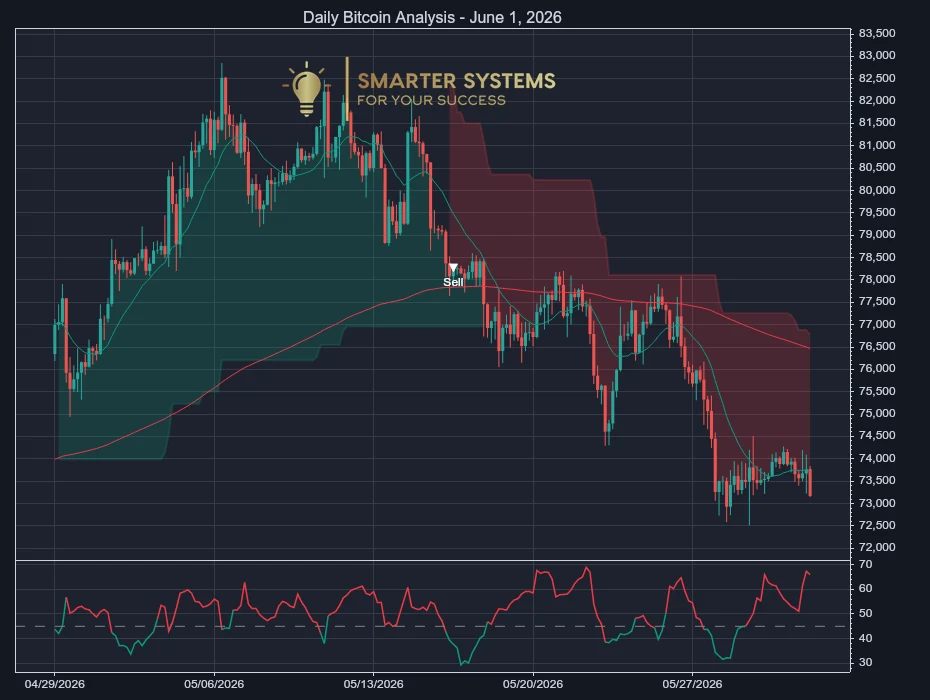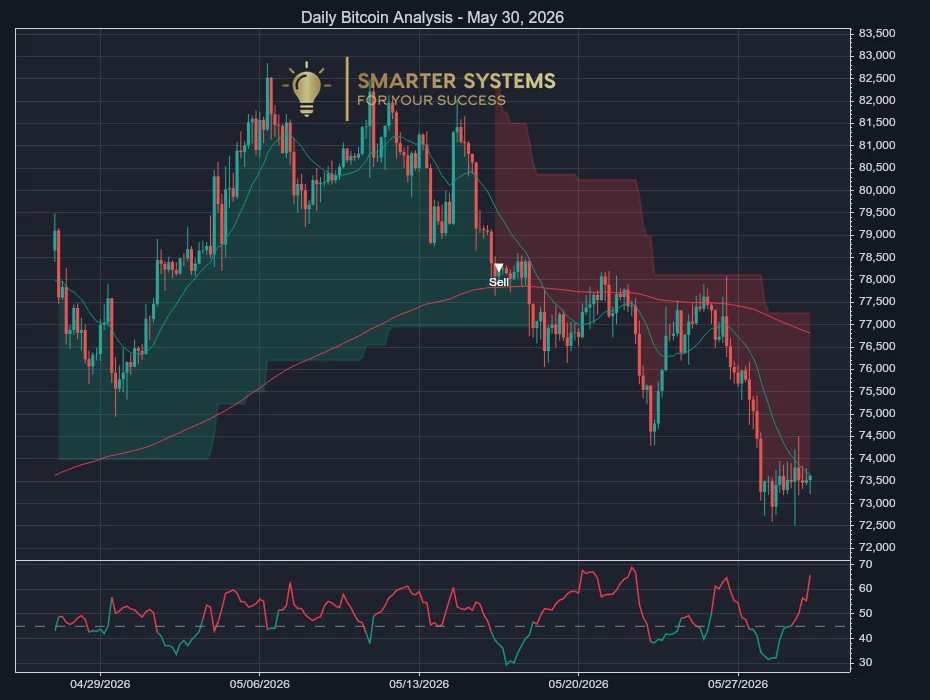
// previous briefing Bitcoin Analysis May 30, 2026: Sellers Press a Choppy Tape
Bitcoin Market Read for May 31, 2026
If you are long Bitcoin, one thing matters more than price this morning. The latest push into higher ground drew noticeably less participation than the prior advance, which makes the Sell signal less about panic and more about tired demand. That distinction matters for investors because a market can look stable while capital is quietly becoming more selective. BTC is not breaking apart, but the burden of proof has shifted back to buyers who need to show that resistance is being absorbed rather than merely tested.
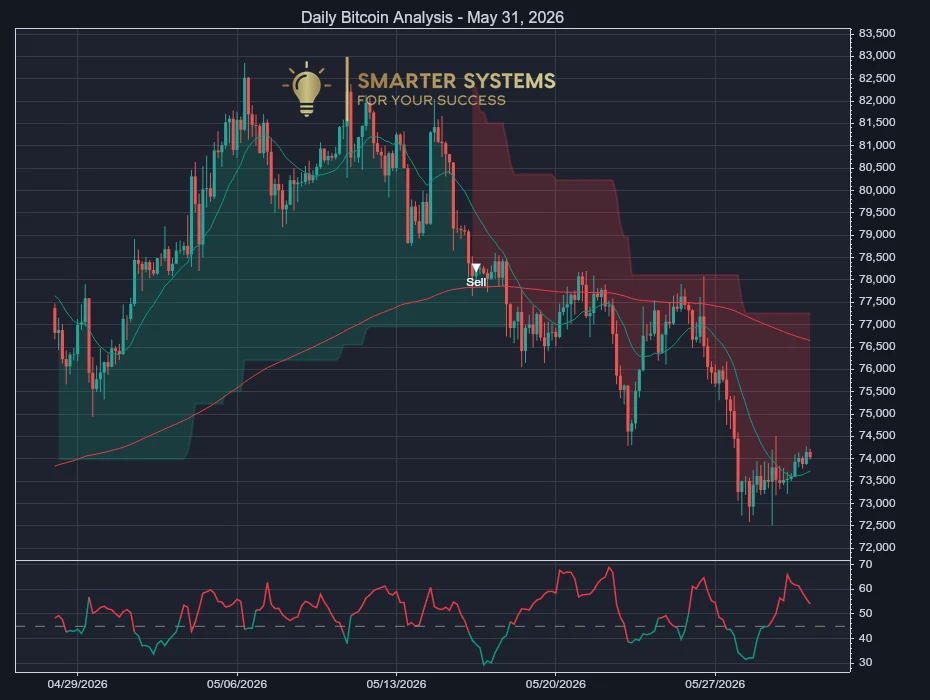
On BTCUSDT, Bitcoin last closed at $74,035 after failing to extend the overnight recovery with any real conviction. The preceding advance lifted price into the upper part of the recent action, but the next move could not carry the same urgency, and sellers appeared sooner than buyers would have wanted. That is the important read: the market did not reject lower prices aggressively, it hesitated near supply. For a portfolio investor, hesitation at resistance is more useful information than a brief uptick, because it shows where fresh capital is unwilling to chase. The current price action still leaves room for short-term bounces, but those bounces are taking place inside a structure where rallies have not yet forced sellers to retreat. Support has not failed in a dramatic way, which is why this is not a liquidation-style warning. It is a more measured caution: the recovery has become less persuasive at the point where stronger participation was needed. That also explains why the system being flat and watching adds credibility rather than indecision; there is not enough evidence of absorption to justify forcing exposure.
Compared with the previous interval, volatility contracted and trading volume fell sharply. In practical terms, the market travelled through a smaller high-low path while fewer coins changed hands, a combination that often signals a pause in commitment rather than a decisive turn. The latest high also sat below the prior attempt, which matters because weaker follow-through near the top of a recovery often shows sellers leaning into strength. This does not automatically make the cryptocurrency market fragile, but it does tell us that capital is not pressing the bid with the same force it showed earlier in the session. The choppy reading fits that behaviour. Price has been moving in overlapping pushes, with enough back-and-forth activity to frustrate clean positioning but not enough buying pressure to change the wider picture. When markets behave like this, the best information usually comes from the quality of reactions: how quickly dips are met, whether rebounds attract size, and whether weakness produces urgent selling or simply drift. At the moment, participation is the tell, because lower activity after a recovery suggests investors are testing, not committing.
Market structure remains the anchor for the read. A confirmed down-trend means the larger sequence still favours sellers, even when the most recent session contains a recovery attempt. The choppy condition changes how that should be handled: it argues against treating every dip as fresh confirmation of weakness, because back-and-forth noise can produce false comfort for both sides. The Sell signal therefore has a specific meaning today. It is not a forecast that Bitcoin must immediately fall; it is a warning that the reward for adding risk has deteriorated while momentum is still failing to broaden. For investors already holding a meaningful allocation, this is the type of signal that supports taking partial profits, reducing tactical exposure, or waiting before deploying new capital. The more subtle point is that sellers do not need to dominate dramatically to keep pressure on the market. They only need to cap rallies often enough that buyers begin to question whether the recovery is worth funding. Until that changes, BTC remains a market where patience carries more value than urgency. That is why cleaner evidence of demand matters more than a small improvement in price from one interval to the next.
Current System Positioning
The system is Flat, status idle, and has been out of position for 89 bars. That stance matches the current read: patience is preferable while the Sell signal and confirmed down-trend remain in place.
What to Watch Next
The most useful marker today is the reaction around the latest intraday low, not the headline price print. The Sell read remains credible while rebounds from that area are slow, shallow, and poorly attended. It starts to break only when a dip is met quickly by larger participation and price reclaims the prior recovery high without stalling at resistance again.
Frequently Asked Questions
It means the setup favours reducing exposure or taking profits rather than adding risk. The latest BTCUSDT move lost participation as the range narrowed, so the signal reads as demand fatigue within a confirmed down-trend, not as a stand-alone crash warning.
Choppiness reflects overlapping pushes and frequent hesitation, not a balanced long-term picture. The broader market structure still favours sellers because recovery attempts are being capped before participation broadens. That combination makes short-term moves less clean while the directional bias remains cautious.
Investors should look for a dip that is absorbed quickly, followed by stronger participation and a reclaim of the prior recovery high. That would show buyers are no longer just defending support, but actively accepting higher prices after the Sell signal.
The system is Flat and idle because the data supports patience rather than forced exposure. A Sell setup can favour trimming risk without requiring a short position. With the position already flat for 89 bars, the process is watching for cleaner evidence before re-entering.
// disclaimer This briefing is educational market commentary from a rule-based system. It is not financial advice and not a personal recommendation. Cryptocurrency is highly volatile, and past signals do not guarantee future results. Only invest money you can afford to lose. Read the full disclaimer.